
Types of Ceramic Tiles — Every Floor and Wall Tile Type Explained
Every fired clay tile is a ceramic tile — porcelain and vitrified tiles included. Tile types get listed by material, by manufacture and by look, often in the same breath, which is why the category is confusing. Sorted properly there are only three questions: what the body is made of, how the surface is decorated, and what it is imitating.
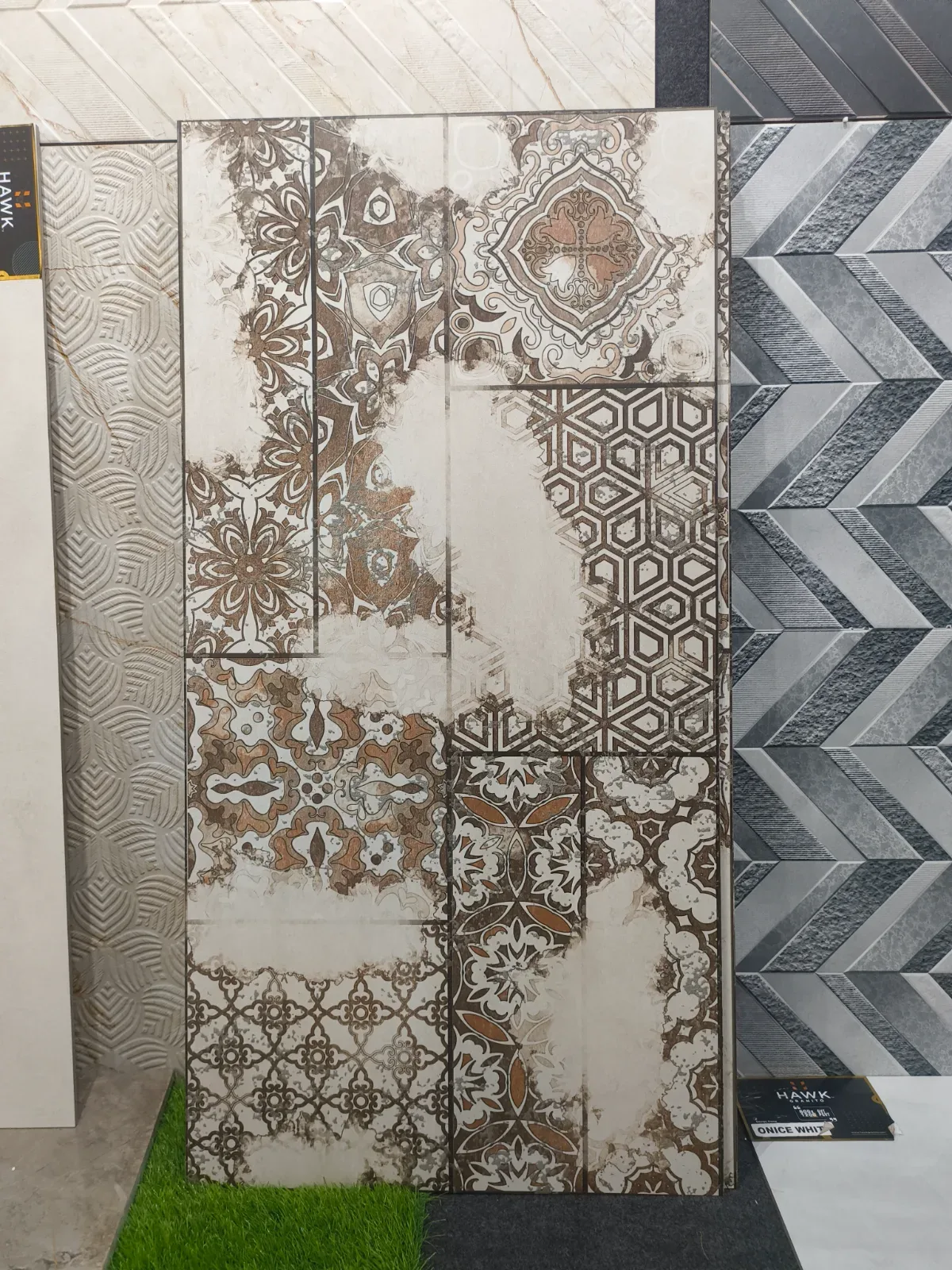
What a ceramic tile is
A ceramic tile is a thin slab of clay and minerals, pressed or extruded into shape and fired in a kiln. Firing turns the clay into a hard, stable body that does not burn, rot or fade. Most tiles are then glazed — coated with a layer of glass that carries the colour or print and seals the surface.
The word ceramic is used in two ways, which causes most of the confusion. In the broad, technical sense every fired clay tile is ceramic, including porcelain and vitrified tiles. In shops, "ceramic tile" usually means the non-porcelain kind: a softer, more porous body fired at a lower temperature, mainly used on walls.
What separates the types of ceramic tiles is how dense the fired body is, measured by how much water it absorbs. The international standards (ISO 13006 and EN 14411) sort every ceramic tile into groups on exactly that basis.
Types of ceramic tiles by water absorption group
| Group | Water absorption | Common name | Typical use |
|---|---|---|---|
| BIa | Up to 0.5% | Porcelain / vitrified | Any floor, wet areas, outdoors, facades |
| BIb | 0.5-3% | Semi-vitrified / stoneware | Floors, light commercial |
| BIIa | 3-6% | Stoneware / red body floor tile | Domestic floors |
| BIIb | 6-10% | Earthenware / ceramic floor | Light domestic floors, walls |
| BIII | Over 10% | Ceramic wall tile (monoporosa) | Interior walls only |
Tile types by body
The body decides where a tile can safely go. Everything else is appearance.
| Type | Water absorption | Use |
|---|---|---|
| Ceramic (non-porcelain) | 3-10% | Interior walls, light domestic floors |
| Porcelain / vitrified | Under 0.5% | Any floor, wet areas, outdoors |
| Full body vitrified | Under 0.5% | Heaviest traffic, stairs, industrial |
| Double charged vitrified | Under 0.5% | Commercial floors, large areas |
| GVT / PGVT | Under 0.5% | Design-led residential and commercial |
| Quarry tile | 3-6% | Unglazed, industrial and traditional floors |
| Terracotta | 10%+ | Interior, traditional, needs sealing |
| Mosaic | Varies by body | Shower floors, feature areas, curves |
| Natural stone | 1-10%+ | Premium, needs sealing and maintenance |
Tile types by surface
- Glazed — A fired glass coating carrying the design. Everything from gloss to deeply textured, but the decoration is thin.
- Unglazed / full body — No coating at all — the body is the surface. Cannot wear through, and can be ground on site.
- Polished — Mechanically buffed to a mirror. Brightest finish, poorest wet grip.
- Matt — Left as fired. Hides marks, gives usable slip resistance.
- Structured / textured — Relief surface for grip, rated R11 or R12 for external and wet use.
- Rectified — Ground to an exact size after firing so joints can be 2 mm or less.
- Sugar / carving finish — Fine grained or relief-carved decorative surfaces.
Tile types by look
Marble Effect Tiles
Veined stone
Carrara, Calacatta, Statuario and dark marbles reproduced in porcelain, without the sealing or etching.
Marble Effect Tiles ›Wood Effect Tiles
Plank formats
Timber grain with surface texture registered to the print, unaffected by water.
Wood Effect Tiles ›Concrete Effect Tiles
Industrial
The cloudiness of a power-floated slab, in a body that does not dust or crack.
Concrete Effect Tiles ›Brick Effect Tiles
Exposed brick
Brick faces and subway formats for feature walls and splashbacks.
Brick Effect Tiles ›Rustic Tiles
Weathered
Aged, riven and tumbled surfaces for traditional and outdoor schemes.
Rustic Tiles ›Terrazzo Tiles
Aggregate chips
Scattered chip patterns in porcelain, without poured terrazzo's cost or cure time.
Terrazzo Tiles ›Granite Effect Tiles
Speckled stone
Salt-and-pepper granite looks in double charged and full body bodies.
Granite Effect Tiles ›3D Tiles
Relief surface
Sculpted and faceted wall tiles that catch light across the surface.
3D Tiles ›Patterned Tiles
Encaustic and border
Repeating geometric and encaustic-look patterns, plus border and inset tiles.
Patterned Tiles ›Frequently asked questions
What are the types of ceramic tiles?
By body: porcelain or vitrified (group BIa, under 0.5% water absorption), semi-vitrified and stoneware (BIb-BIIa), earthenware floor tiles (BIIb) and porous ceramic wall tiles (BIII). Vitrified tiles are further divided into full body, double charged, GVT and PGVT by how the surface is decorated.
What is a ceramic tile?
A slab of clay and minerals pressed into shape and fired in a kiln, usually with a glass glaze on top. Technically all fired clay tiles are ceramic, including porcelain; in shops the term usually means the softer, more porous wall and light-floor tiles.
What are the main types of tiles?
By body: ceramic, porcelain or vitrified, full body, double charged, GVT, PGVT, quarry, terracotta, mosaic and natural stone. By surface: glazed, unglazed, polished, matt, structured and rectified. By look: marble, wood, concrete, brick, rustic, terrazzo, granite, 3D and patterned.
What types of tiles are used for flooring?
Porcelain and vitrified in all their forms — full body, double charged, GVT and PGVT — plus quarry tile for industrial floors and natural stone at the premium end. Non-porcelain ceramic is only suitable for light domestic floors and is better kept to walls.
Which type of tile is the most durable?
Full body vitrified porcelain. Because the colour runs through the entire thickness there is no decorative layer that can wear away, so it ages evenly under the heaviest traffic. Double charged is the next step down and covers most commercial needs.
What is the difference between floor tiles and wall tiles?
Strength and slip resistance. A floor tile is thicker, denser and rated for abrasion and wet grip. A wall tile need only carry its own weight, so it is lighter and often more porous. Floor tiles can always go on walls; wall tiles must never go on floors.
Not sure which type you need?
Describe the room, the traffic and the climate and we will tell you which body and surface to specify.
Browse the full range
Buying Guides
- Tile Buying Guide
- Full Body vs GVT Tiles
- Step & Riser Tiles Guide
- GVT vs PGVT
- Tile Size Guide
- Laminate Guide
- Porcelain vs Ceramic Tiles
- What Are Vitrified Tiles
- Types of Tiles
- Tile Thickness Guide
+21 more
- Glossy vs Matte Tiles
- How to Clean Tile Floors
- How to Remove Tile Stains
- How to Fix Cracked Tiles
- How to Clean Marble Floors
- Bathroom Size Guide
- Powder Room Guide
- Epoxy Flooring vs Tiles
- Wall Tiles vs Floor Tiles
- Small Bathroom Ideas on a Budget
- How to Clean Kitchen Tiles
- How to Remove Tile Scratches
- Floor Tile Border Designs
- Indian Flooring Tiles
- Indian Toilet Bathroom Design
- Kitchen Dado Tiles
- Wash Basin Counter Design
- Flush Valve vs Flush Tank
- Wall vs Floor Mounted Toilet
- Portico Design
- Outside Stairs Design